Models train directly on the live GPU simulation through our CUDA bridge, with WL3 hypergraph metrics computed by the solver itself during training. The solver physics runs alongside inference, self healing their predictions, as in our bucket excavator agent.
The solver library runs inside the Python process. Models train on the live GPU simulation and run beside it at inference, with no copies and no files between them.
CUDA device pointers to positions, orientations, velocities, forces, polyhedron state and Element stress are used as PyTorch and CuPy tensors in place, so models train on the running simulation.
The solver itself computes WL3 hypergraph metrics of the full contact network during training; the high fidelity data trains a hypergraph neural network that learns how the process itself works, such as mixing.
The solver physics runs alongside inference: networks and controllers act in the middle of a time step, and Jacobi relaxation pushes their predictions back to physical states on the GPU.
Training frames with the full contact network to HDF5, or live coupling with no files, for AI physics surrogates, robotics training, reinforcement learning and digital twins.
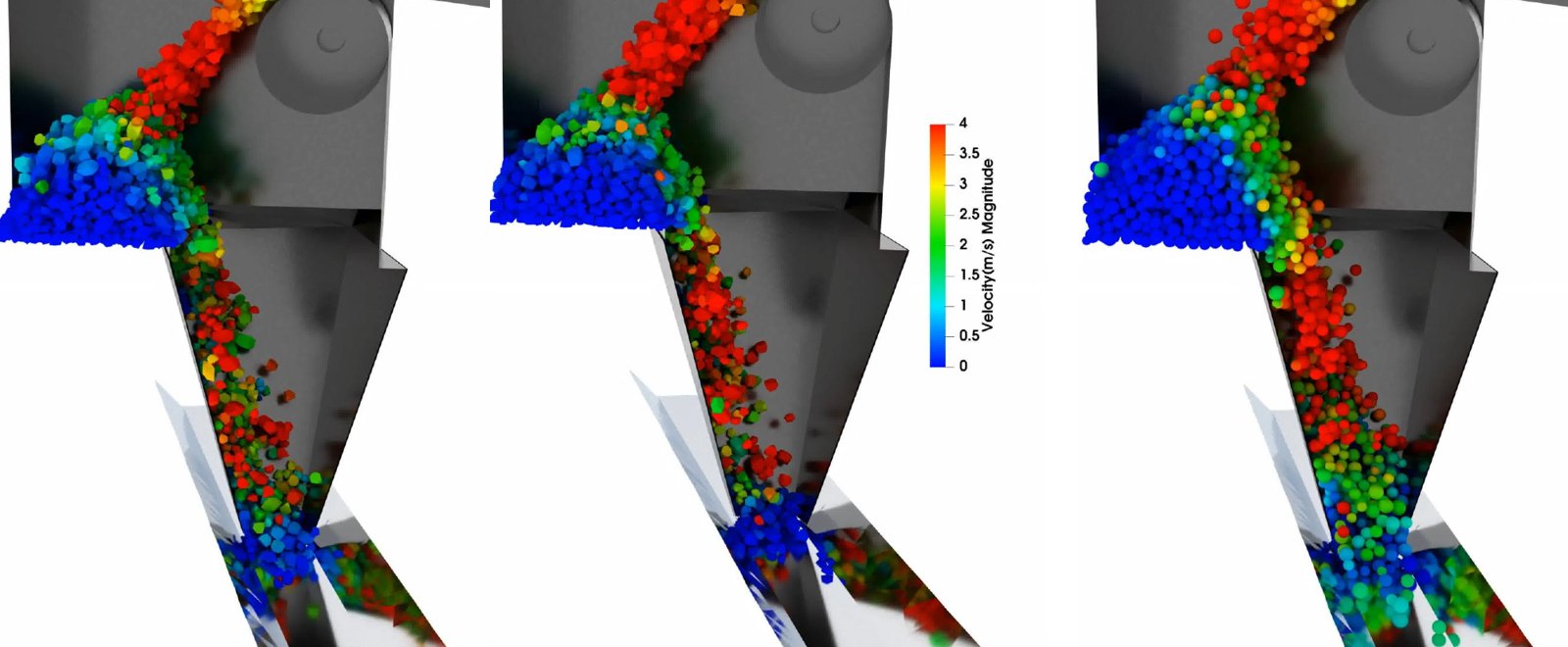
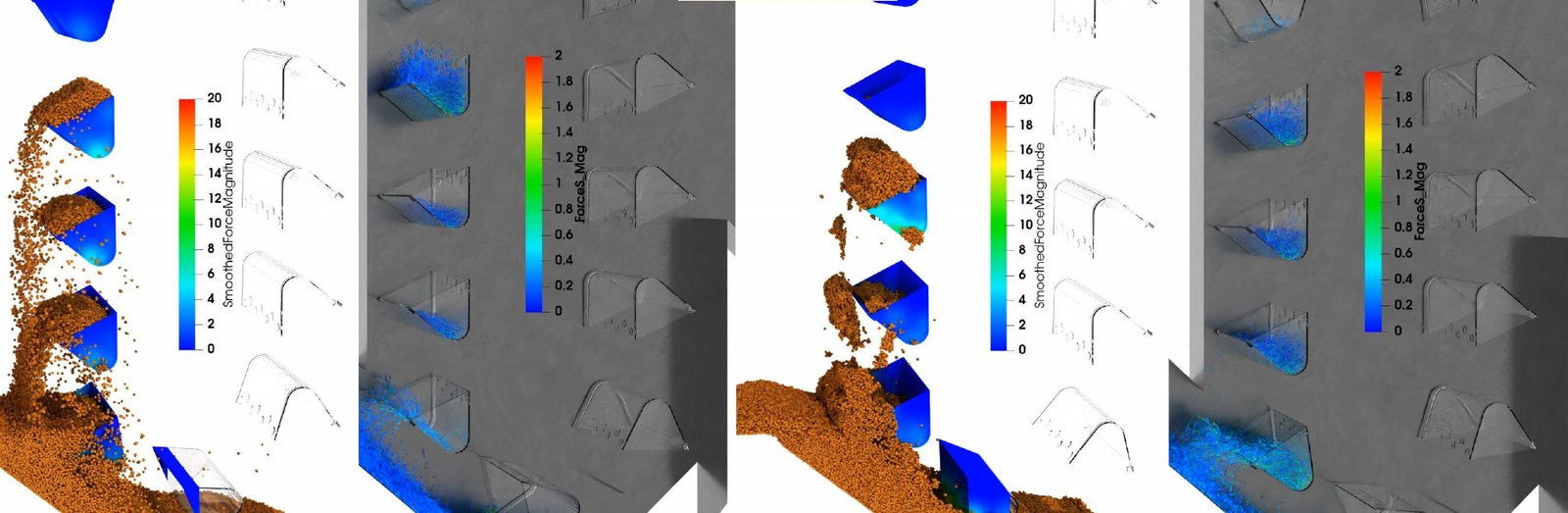
A learned controller trained on calibrated GPU DEM runs infers the hidden particle state from the drive signals and checks its predictions against a live DEM simulation.
The DEM of the buckets is calibrated against the real machine. Cohesion cases (clay binder, freezing) build a database of sensor and motor signals to DEM states: contacts, payload, force chains, rock fragments.
Pre-trained on recorded DEM runs, then the agent acts in closed loop: speed change, jog, reverse. Blaze returns the physical response and the agent learns the causal effect.
During operation the agent infers force chains, payload and boulder obstacles from the drive signals alone: torque, tension, power and speed.
Predicted high tension states are checked against a live DEM simulation, avoiding high-tension events and improving fill per pass.
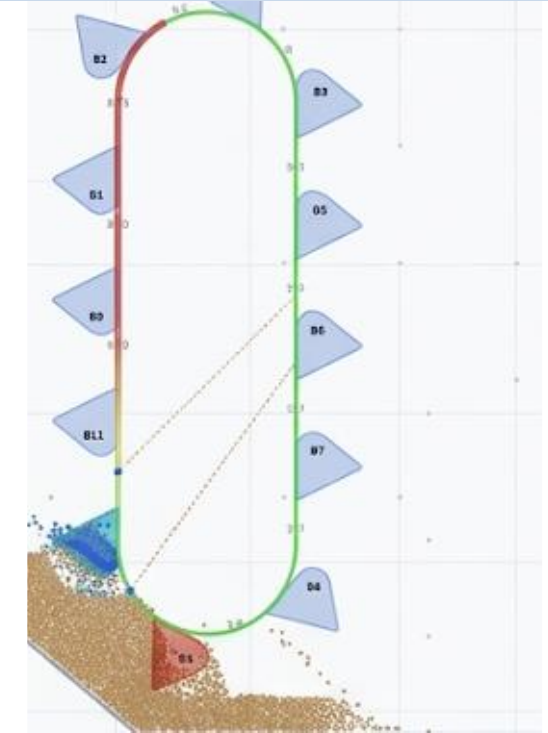
The agent compares short windows of drive torque with the learned torque signature library and classifies the machine state: